
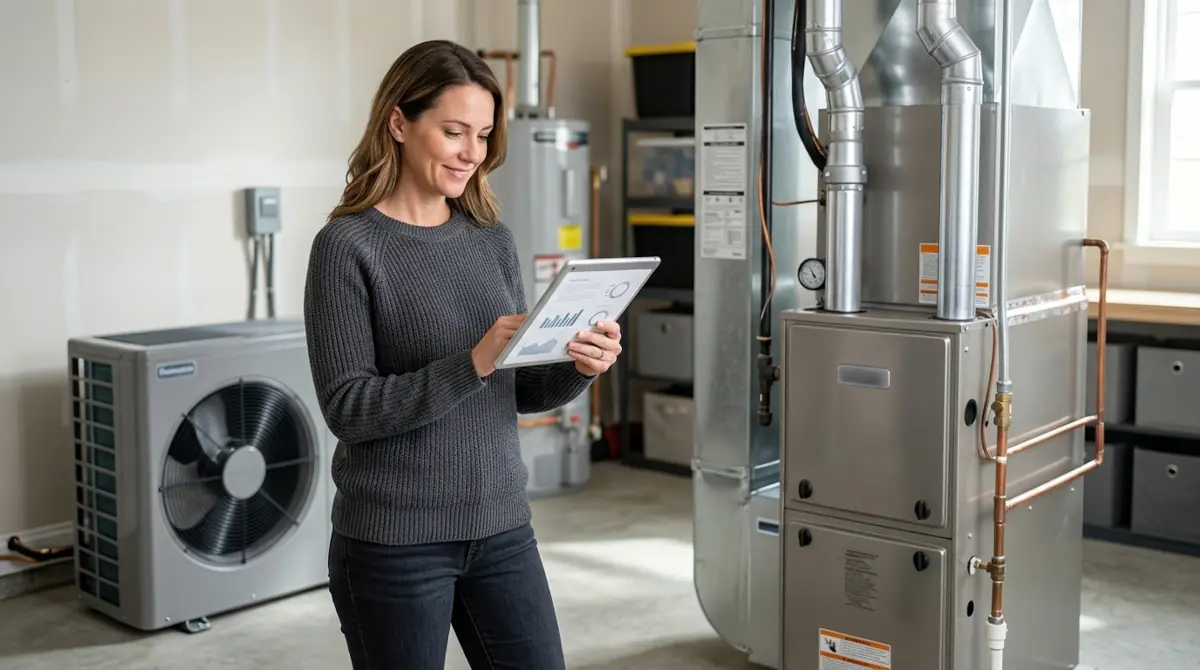
When weighing the gas furnace vs heat pump cost in 2026, the financial picture has shifted more dramatically than most homeowners expect. Heat pumps outsold gas furnaces by 26% in 2025, marking the official arrival of the electric heating era, and that trend is accelerating this year as rebates deepen and equipment prices stabilize.
Whether you are focused on residential heating, residential cooling, or looking for one system to do both, understanding the true cost comparison is the foundation of a smart decision for your home.
Key Takeaways: Gas Furnace vs Heat Pump Cost 2026
| Question | Quick Answer |
|---|---|
| What does a gas furnace installation cost in 2026? | $3,500 to $7,500 with existing ductwork in place |
| What does a heat pump installation cost in 2026? | $2,000 to $5,000 more than a comparable furnace plus AC installation |
| Which system costs less to operate? | Heat pumps typically cost less annually, with average savings of $650 per year for a 1,800 sq. ft. home |
| Does California favor one system over the other? | Yes. California’s 2023 Energy Code and available rebates strongly favor heat pumps for new and replacement installations |
| Is a hybrid (dual fuel) system a viable middle option? | Absolutely. A dual fuel system pairs a heat pump with a gas furnace backup, balancing efficiency and reliability |
| Are there rebates available in Sonoma County in 2026? | Yes. Federal tax credits and PG&E incentive programs remain active and can significantly offset heat pump installation costs |
| Who can I talk to about which system suits my home? | Contact Dale HCS directly for a free, no-pressure estimate tailored to your specific home |
Understanding the Full Gas Furnace vs Heat Pump Cost 2026 Breakdown
Most homeowners focus on the sticker price at installation and miss the bigger picture. The real cost of any HVAC system includes purchase price, installation labor, operating costs, maintenance, and eventual replacement, all tallied over the system’s usable life.
Here is how the two systems compare across each cost category in 2026:
-
Gas Furnace Installation Cost: With existing ductwork already in your home, a new gas furnace installation typically runs between $3,500 and $7,500. This figure covers the unit, labor, and standard connections.
-
Heat Pump Installation Cost: A comparable heat pump system generally adds $2,000 to $5,000 over a traditional furnace-plus-AC configuration. However, a heat pump replaces both systems at once, which changes the value equation considerably.
-
Electrical Upgrades: Some older Sonoma County homes require a panel upgrade to accommodate a heat pump, which can add $1,500 to $3,500 to the project. We always assess this during our initial home evaluation so there are no surprises.
-
Annual Operating Costs: Heat pumps move heat rather than generate it, making them significantly more efficient. At 5 degrees Fahrenheit, a modern cold-climate heat pump delivers 1.9 units of heat per unit of electricity, nearly double the 0.96 units from a high-efficiency gas furnace.
-
Maintenance Costs: Both systems require annual service. Gas furnaces involve combustion components, heat exchangers, and flue systems. Heat pumps involve refrigerant circuits and electrical components. Neither is inherently more expensive to maintain when serviced regularly.
Best for Upfront Savings: The Gas Furnace
If your primary concern is keeping the installation cost as low as possible right now, a gas furnace remains the lower upfront investment in 2026, particularly when your home already has ductwork and an existing gas line.
A gas furnace is best suited for:
-
Homeowners with an existing gas connection and serviceable ductwork
-
Properties where an electrical panel upgrade would be cost-prohibitive
-
Homeowners planning to sell within three to five years who want to minimize capital outlay
-
Situations where a quick replacement of a failed unit is needed without system redesign
We offer a full range of residential heating services, including gas furnace installation, repair, and maintenance throughout Sonoma County. When a furnace is the right call for your home, we will tell you honestly, not push you toward a more expensive option.
“We never approach a home with a cookie-cutter recommendation. We look at your ductwork, your electrical panel, your gas line, and your usage patterns before we suggest anything. That diagnostic discipline is what separates a genuinely good recommendation from a sales pitch.”
Did You Know?
9 out of 10 heat pump owners (90%) would recommend the technology to others based on comfort and efficiency.
Source: flynzoheat.com
Best for Long-Term Savings: The Heat Pump
When the conversation moves to total cost of ownership across a 15 to 20-year system lifespan, the heat pump consistently outperforms a gas furnace in 2026 climate and utility conditions, especially here in Northern California.
Several factors drive this advantage for Sonoma County homeowners specifically:
-
Sonoma County’s Mild Winters: Heat pumps perform at maximum efficiency in temperatures above 35 to 40 degrees Fahrenheit, which describes the vast majority of our heating season in Santa Rosa, Petaluma, Rohnert Park, Sebastopol, and Windsor. The deep-cold penalty that affects heat pumps in colder climates barely applies here.
-
Dual Function (Residential Heating and Cooling): A single heat pump replaces both your furnace and your AC unit. When you factor in the cost of replacing both systems separately, the heat pump’s higher upfront price becomes far more competitive. Our residential cooling services page outlines how this integration works in practice.
-
Fixed Gas Connection Fees: Homeowners can save $20 to $40 per month, or $240 to $480 annually, simply by eliminating their fixed gas connection fee when they fully electrify. Over a 15-year system life, that is $3,600 to $7,200 in pure savings before accounting for any efficiency gains.
-
Available Incentives in 2026: Federal tax credits under the Inflation Reduction Act and PG&E rebate programs remain active in 2026. Depending on your household income and the equipment selected, these programs can offset $2,000 to $8,000 of your installation cost.
Gas Furnace vs Heat Pump Cost 2026: Side-by-Side Comparison Table
| Cost Factor | Gas Furnace | Heat Pump |
|---|---|---|
| Installation Cost (with ductwork) | $3,500 to $7,500 | $5,500 to $12,500 |
| Replaces AC Unit? | No (separate AC needed) | Yes |
| Typical Annual Operating Cost (1,800 sq. ft.) | Higher by approx. $650/year | Lower by approx. $650/year |
| Federal Tax Credit Available (2026) | Limited | Up to $2,000 |
| Lifespan | 15 to 20 years | 15 to 20 years |
| Best Suited For | Low upfront cost priority, existing gas infrastructure | Long-term savings, all-electric homes, dual-purpose heating and cooling |
| California Energy Code Alignment | Increasingly restricted for new builds | Preferred and incentivized |
Best for Flexibility: The Dual Fuel (Hybrid) System
For many Sonoma County homeowners, the gas furnace vs heat pump cost debate does not have to result in an either-or decision. A dual fuel system, sometimes called a hybrid system, pairs an electric heat pump with a gas furnace backup.
This configuration gives your home the best of both worlds:
-
The heat pump operates at high efficiency during mild weather, covering the majority of heating and cooling days in our climate
-
The gas furnace kicks in automatically on the rare days when temperatures drop low enough to reduce heat pump efficiency
-
You retain your gas line as backup infrastructure while still qualifying for heat pump rebates and incentives
We have installed dual fuel systems throughout Santa Rosa, Rohnert Park, and the surrounding micro-regions and consistently find they are an excellent fit for homes where full electrification requires a significant panel upgrade. The system allows homeowners to move toward electric heating on their own timeline without sacrificing reliability.
What California’s Gas Furnace Regulations Mean for HVAC Costs in 2026
California’s approach to HVAC regulation is directly relevant to the gas furnace vs heat pump cost conversation in 2026. If you have been following local news, you have likely heard about the state’s push toward electric heating systems.
The California 2023 Energy Code. targets new residential construction by requiring or strongly incentivizing all-electric heating. Existing homes retain flexibility, but the policy direction is clear: the long-term regulatory and financial environment favors heat pumps.
For Sonoma County homeowners, this means:
-
If you are replacing a failed furnace in an existing home, you are not currently required to switch to a heat pump, but incentive structures make it financially attractive to do so
-
If you are building a new home or completing a major renovation, heat pump systems are likely required or heavily preferred under current code
-
Investing in a gas furnace today carries the risk that future code changes or gas utility rate increases will reduce its cost advantage over its lifespan
We have written a detailed resource specifically for Sonoma County homeowners navigating these changes. We encourage you to read our guide on California’s gas furnace phase-out and what it means for your home before making a final decision.
The HVAC Cost Factor Most Homeowners Overlook: Ductwork
Whether you choose a gas furnace or a heat pump, the condition of your existing ductwork can have a significant impact on both installation cost and long-term operating efficiency. Leaky or undersized ducts can reduce system performance by 20 to 30 percent regardless of how efficient the equipment itself is.
This is precisely why we do not approach your home with a pre-decided recommendation. Before we quote any system, we assess your ductwork to identify leakage or sizing problems that would undermine your investment. In many cases, resolving a duct issue is the single highest-return improvement a homeowner can make.
Our team also offers custom sheetmetal fabrication services, which means we can design and build ductwork components specifically sized for your home’s layout. This is a capability that most HVAC contractors simply do not offer, and it matters significantly for both system performance and long-term cost.
Did You Know?
Energy-efficient, all-electric homes with heat pumps sell for up to 15% more than those with traditional gas systems.
Source: nuwattenergy.com
Residential Heating and Cooling Solutions for Sonoma County’s Climate Zones
Sonoma County is not a single climate. Santa Rosa experiences different temperature swings and air quality challenges than the coastal communities near Bodega Bay. Inland valleys like Windsor and Petaluma have distinct humidity profiles. These micro-regional differences matter when selecting between a gas furnace and a heat pump.
We have served every corner of Sonoma County since our founding in 1993, and that local experience informs every system recommendation we make. Here is how the climate context affects the decision:
-
Santa Rosa and Rohnert Park: Moderate winters with occasional wildfire smoke infiltration during late summer and fall. Heat pumps paired with quality filtration provide effective residential heating and residential cooling while supporting air quality management.
-
Petaluma and Coastal Areas: Higher humidity and milder temperatures year-round. Heat pumps operate near peak efficiency in these conditions and handle summer cooling demands efficiently.
-
Sebastopol and Inland Valleys: Slightly cooler winters but still well within the operating range where heat pumps maintain strong efficiency. Dual fuel systems are a popular choice here for homeowners who want backup gas heating during rare cold snaps.
-
Windsor: Warm, dry summers and moderate winters make it one of the stronger cases for a pure heat pump approach, given cooling demand and mild heating requirements.
Understanding these distinctions is exactly what we mean when we say we do not sell off-the-shelf solutions. Your neighbor’s system may not be the right system for you, even on the same street.
Ductless Mini-Split Systems: A Third Option Worth Considering
When evaluating the gas furnace vs heat pump cost in 2026, a subset of homeowners discovers that a ductless mini-split system is actually the most cost-effective path for their specific situation.
Mini-splits are heat pump systems that do not require ductwork. They are particularly well suited for:
-
Homes without existing duct systems where installing new ductwork would add $3,000 to $8,000 to the project cost
-
Room additions, converted garages, or detached accessory dwelling units
-
Homeowners who want zoned residential heating and AC without a full system overhaul
A ductless mini-split delivers both heating and AC in one unit per zone. Installation costs are generally competitive with a full ducted heat pump when ductwork installation would otherwise be required. We carry and install multiple mini-split configurations and can assess whether this approach makes financial sense for your home.
How Dale HCS Approaches the Gas Furnace vs Heat Pump Cost Decision
We have been helping Sonoma County families with their HVAC decisions since 1993. Over three decades, we have learned that the homeowners who get the best long-term value are the ones who start with an honest diagnostic conversation rather than a product pitch.
Our process works like this:
-
Home Assessment: We evaluate your existing ductwork, electrical panel, gas infrastructure, insulation, and square footage before recommending anything.
-
Honest Options Presentation: We present you with all viable options, including the gas furnace vs heat pump cost comparison specific to your home, with no pressure toward any particular outcome.
-
Rebate and Incentive Review: We identify every available incentive for which you qualify, from federal tax credits to PG&E programs, and factor those into your actual out-of-pocket cost estimate.
-
Free Estimate: We provide a written, itemized estimate at no charge. Upfront pricing is a standard part of how we operate, not something you have to request.
-
Emergency Availability: If your system has already failed and you are making a decision under pressure, we are available around the clock with no overtime charge, ever.
To schedule your free home assessment or speak directly with our team, visit our contact page and ask for Ashley or Daniele. We are your neighbors in Sonoma County, and your family’s comfort is our genuine priority.
Conclusion: Which System Wins the Gas Furnace vs Heat Pump Cost 2026 Comparison?
The gas furnace vs heat pump cost comparison in 2026 does not have a single universal answer, but it does have a clear directional trend. For most Sonoma County homeowners, the heat pump delivers superior long-term value when installation incentives, operating efficiency, and the dual function as both a heating and AC system are factored in.
The gas furnace retains a genuine advantage in upfront cost and may be the right call for specific situations, particularly where electrical infrastructure needs significant upgrading or where the homeowner’s timeline does not allow for a longer payback period.
The dual fuel hybrid system bridges the gap for homeowners who want efficiency without fully committing to all-electric operation today. And for homes without existing ductwork, a ductless mini-split may reframe the entire cost comparison in favor of electrification from the start.
What we know after more than 30 years of serving this community is that the right answer begins with an honest look at your specific home, not a general rule applied uniformly to every situation. We invite you to have that straightforward conversation with us. Reach out today for your free estimate, and let us help you make the best decision for your family and your budget.
Frequently Asked Questions
Is a heat pump worth it in 2026 given the higher upfront cost?
For most Sonoma County homeowners, yes. In 2026, heat pump rebates and tax credits can offset $2,000 to $8,000 of installation cost, and the system replaces both furnace and AC in a single purchase. When operating savings of approximately $650 per year are added in, most homeowners recover the cost premium within five to eight years.
What is the real cost difference between a gas furnace and a heat pump in 2026?
A gas furnace installation with existing ductwork runs $3,500 to $7,500, while a heat pump system typically adds $2,000 to $5,000 over a comparable furnace-plus-AC configuration. However, factoring in available incentives and the dual heating and cooling function, the net cost gap is smaller than it initially appears.
How much can I save on energy bills by switching from a gas furnace to a heat pump?
The average annual operating cost savings for a 1,800 sq. ft. home switching from a gas furnace to a heat pump is approximately $650. Additionally, eliminating your fixed gas connection fee can save a further $240 to $480 per year depending on your utility provider.
Do I need to upgrade my electrical panel to install a heat pump?
Many homes in Sonoma County, particularly those built before 1990, require an electrical panel upgrade when switching to a heat pump. This typically adds $1,500 to $3,500 to the project cost. We assess your panel capacity during our initial home evaluation so you have a complete picture before committing to any equipment.
What is a dual fuel system and when does it make sense for the gas furnace vs heat pump cost comparison?
A dual fuel system combines a heat pump with a gas furnace backup, using the heat pump for most of the heating season and the gas furnace on the coldest days. In 2026, it is an excellent middle-ground option for Sonoma County homes where full electrification requires a costly panel upgrade, as it qualifies for heat pump rebates while retaining gas backup reliability.
Is a ductless mini-split a better option than a traditional heat pump or gas furnace for my home?
If your home lacks existing ductwork or you are adding a room addition or accessory dwelling unit, a ductless mini-split may actually be the most cost-effective HVAC solution in 2026. It provides both residential heating and AC without the cost of installing new duct systems, and it operates with the same high-efficiency principles as a standard heat pump.
How does California’s gas furnace phase-out affect my buying decision in 2026?
California’s 2023 Energy Code restricts gas heating systems in new residential construction and strongly incentivizes electric alternatives. While existing homes retain flexibility for gas furnace replacements in 2026, the regulatory and financial trend clearly favors heat pumps. Choosing a gas furnace today carries a risk that future code changes will limit your options during the next replacement cycle.