

When summer temperatures climb in Sonoma County, your family’s comfort becomes a top priority. Ductless air conditioners offer a flexible, energy-efficient solution for cooling specific areas of your home—but their effectiveness depends entirely on proper placement. Unlike traditional central air systems that rely on extensive ductwork, ductless units give you the freedom to target cooling where you need it most. Understanding the best installation locations can mean the difference between a consistently comfortable home and one with frustrating hot spots that leave your family searching for relief.
The beauty of ductless systems lies in their versatility. Whether you’re adding cooling to a recently converted garage, upgrading an older home without existing ductwork, or simply wanting better temperature control in specific rooms, these systems adapt to your unique needs. However, this flexibility also means making informed decisions about placement—decisions that affect everything from energy efficiency to long-term comfort. Let’s explore the key considerations that will help you maximize your investment and keep your family comfortable throughout our warm California seasons.
| Installation Factor | Key Considerations |
|---|---|
| Indoor Unit Placement | Mount 7-8 feet high on interior walls with unobstructed airflow for optimal cooling distribution throughout the room |
| Outdoor Unit Location | Position on stable ground or wall brackets with adequate clearance, away from direct sunlight and debris sources |
| Room Selection | Prioritize high-use spaces like bedrooms, living rooms, and home offices where comfort matters most to your family |
| Technical Requirements | Ensure proper electrical access, drainage routing, and line set connections between indoor and outdoor components |
| Efficiency Factors | Consider sun exposure, insulation quality, and room size to match system capacity with cooling demands |
Understanding Indoor Unit Placement for Maximum Comfort
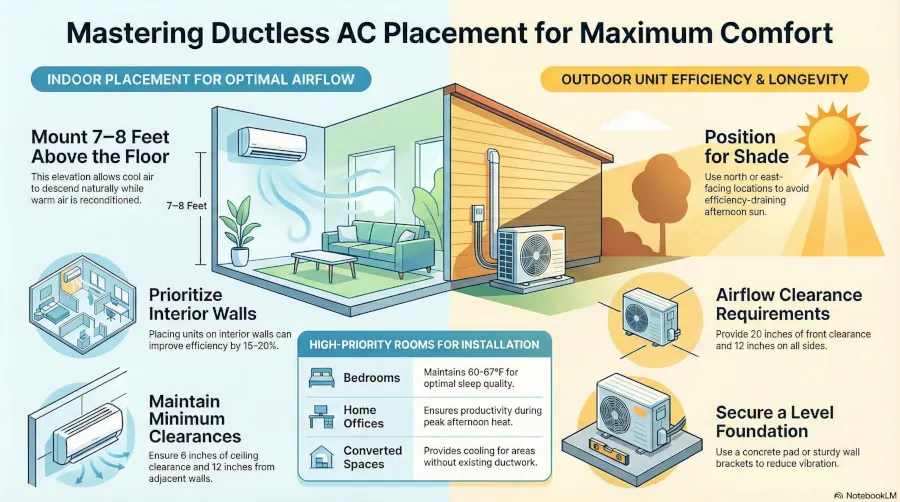
The indoor unit of your ductless system serves as the primary cooling distribution point for each room, and its placement significantly impacts how effectively it maintains comfortable temperatures. Most professionals recommend mounting these units high on an interior wall—typically between seven and eight feet from the floor. This elevated position takes advantage of natural air circulation patterns, allowing cool air to descend gradually throughout the space while warm air rises to be reconditioned. When installed at the proper height, your family experiences consistent comfort without the drafty feeling that can occur with poorly positioned units.
Wall selection matters just as much as mounting height. The ideal wall provides unobstructed airflow paths and sits away from direct sunlight exposure, which can interfere with the unit’s temperature sensors and reduce efficiency. Interior walls often work better than exterior ones because they’re not affected by outdoor temperature fluctuations that can stress the system. You’ll also want to avoid placing units directly above heat-generating appliances, televisions, or other electronics that might confuse the temperature sensors. Our experience with local homes has shown that thoughtful wall selection can improve efficiency by 15-20% compared to rushed placement decisions.
Furniture arrangement and room layout deserve careful consideration during the planning phase. The indoor unit needs clear space around it—typically at least six inches from the ceiling and twelve inches from adjacent walls or corners—to function properly. Bookshelves, tall cabinets, or curtains that block airflow will force your system to work harder, increasing energy costs and reducing your family’s comfort. If you’re planning to install a ductless system in a living room or bedroom, think about your current and future furniture placement to ensure the unit can distribute air freely throughout the space. This forethought prevents the common frustration of realizing your perfect unit placement conflicts with your family’s living arrangements.
Selecting the Right Rooms for Ductless Installation
Not every room in your home requires a ductless unit, and part of maximizing your investment involves prioritizing spaces based on usage patterns and comfort needs. Bedrooms consistently rank as top candidates because quality sleep depends on comfortable temperatures—research from the National Sleep Foundation suggests the ideal bedroom temperature falls between 60-67°F. A ductless unit gives each family member control over their personal comfort without affecting the rest of the house. Home offices have also become prime locations as remote work becomes more common, ensuring productivity doesn’t suffer during warm afternoons.
Living rooms and family gathering spaces offer excellent opportunities for ductless installation, particularly if these areas receive afternoon sun exposure that overwhelms your existing cooling system. These high-traffic zones benefit from targeted cooling without the energy waste of conditioning your entire home. Converted spaces present some of the strongest cases for ductless systems—finished garages, sunrooms, additions, and in-law units often lack access to existing ductwork, making ductless the most practical and cost-effective solution. For local families dealing with our region’s temperature variations, these flexible systems provide comfort exactly where it’s needed.
When evaluating which rooms deserve priority, consider these practical factors that affect both immediate comfort and long-term satisfaction:
- Usage frequency: Rooms your family occupies most during warm weather deliver the best return on your cooling investment, while rarely-used spaces can often manage with less intervention.
- Sun exposure patterns: West and south-facing rooms absorb more heat throughout the day, creating temperature challenges that ductless systems handle efficiently with targeted cooling.
- Existing ventilation limitations: Rooms far from your central air returns or with inadequate airflow benefit significantly from dedicated ductless units that don’t depend on existing infrastructure.
- Special temperature needs: Spaces with sensitive electronics, musical instruments, or family members with specific comfort requirements justify dedicated climate control.
- Privacy considerations: Ductless systems operate more quietly than traditional central air, making them ideal for bedrooms where noise disrupts sleep or home offices where concentration matters.
Outdoor Unit Positioning and Technical Considerations
While indoor unit placement affects comfort directly, outdoor unit location determines your system’s efficiency, longevity, and maintenance requirements. The outdoor condenser requires a stable, level surface—either ground-mounted on a concrete pad or wall-mounted using sturdy brackets rated for the unit’s weight and vibration. Ground installations typically prove more accessible for maintenance and repairs, though wall mounting works well when ground space is limited or when protecting the unit from potential flood conditions. Regardless of mounting method, the location must provide adequate clearance on all sides, typically 20 inches in front and 12 inches on other sides, allowing proper airflow and service access.
Environmental factors significantly impact outdoor unit performance and lifespan. Here in Sonoma County, our experience shows that units positioned on the north or east side of homes tend to operate more efficiently than those exposed to afternoon western sun. Direct sunlight forces the condenser to work harder, increasing energy consumption and wear on components. Similarly, positioning units away from dryer vents, irrigation spray, falling leaves, and debris sources reduces maintenance needs and extends equipment life. Consider these placement priorities when selecting your outdoor unit location:
- Shade protection: Natural shade from trees or structures helps maintain efficiency, though avoid placing units directly under deciduous trees that drop leaves and debris seasonally.
- Noise considerations: Position condensers away from bedroom windows, outdoor entertainment areas, and property lines where operational noise might disturb your family or neighbors.
- Drainage planning: Ensure the location allows proper condensate drainage without creating puddles, erosion, or moisture problems near your home’s foundation.
- Future access: Leave sufficient space for technicians to perform routine maintenance and repairs without navigating through landscaping obstacles or tight spaces.
- Line set routing: Minimize the distance between indoor and outdoor units when possible, as shorter refrigerant line runs improve efficiency and reduce installation complexity.
The technical connection between indoor and outdoor units requires professional expertise to ensure proper function and efficiency. The refrigerant line set, electrical wiring, and condensate drain must route through your home’s structure, typically requiring a three-inch diameter hole through an exterior wall. Professional installers carefully seal these penetrations to prevent air leaks, moisture intrusion, and pest entry—critical details that protect both your HVAC investment and your home’s structural integrity. The line set can typically span up to 50 feet, though shorter runs generally deliver better efficiency and lower installation costs. Our local expertise helps identify routing paths that minimize visual impact while maintaining system performance, ensuring your ductless installation looks clean and functions optimally for years to come.
Optimizing Performance Through Strategic Placement
Even perfectly selected rooms and properly positioned units won’t deliver their full potential without considering how placement affects overall system performance. Room size and ceiling height directly influence the capacity requirements of your ductless unit—a 12,000 BTU system that comfortably cools a standard bedroom will struggle in a large, open-concept space with vaulted ceilings. According to the U.S. Department of Energy, properly sizing your cooling equipment is essential for energy efficiency and comfort. Professional load calculations account for insulation levels, window sizes, sun exposure, and occupancy patterns to match equipment capacity with actual cooling demands, preventing the inefficiency and discomfort that comes from undersized or oversized systems.
Multiple indoor units connected to a single outdoor condenser offer whole-home comfort with independent temperature control for different zones. This configuration works beautifully for families with varying comfort preferences or for homes with distinct usage patterns throughout the day. However, strategic placement becomes even more critical when coordinating multiple units. Balance the cooling load across zones, consider how air movement between rooms affects overall comfort, and ensure each unit can operate efficiently without fighting against others. For example, cooling a master bedroom and adjacent bathroom might require only one unit if positioned correctly, while two distant bedrooms would each benefit from dedicated units for optimal comfort and efficiency.
Your home’s existing infrastructure influences placement possibilities more than many homeowners initially realize. Electrical panel capacity determines whether upgrades are necessary to support new equipment, while wall construction affects mounting options and installation complexity. Homes with concrete or stone walls present different challenges than wood-frame construction, sometimes requiring specialized mounting hardware or alternative placement strategies. Similarly, your home’s age and insulation quality impact how well ductless systems maintain comfort—older homes with minimal insulation may need higher-capacity units or additional zones to compensate for thermal losses. These factors don’t prevent successful ductless installation, but they do require professional assessment to develop the most effective approach for your specific situation. Our experience with Sonoma County’s diverse housing stock helps identify these considerations early, avoiding surprises and ensuring your ductless system delivers the comfort and efficiency your family deserves.
Indoor Unit Placement
Mount 7-8 feet high on interior walls for optimal cooling distribution.
Outdoor Unit Location
Position on stable ground with shade, away from sunlight and debris.
Room Selection
Prioritize high-use spaces like bedrooms and living rooms for comfort.
Technical Requirements
Ensure proper electrical access, drainage, and line set connections.
Making Your Ductless Installation Decision
Ductless air conditioners offer remarkable flexibility for targeted cooling, but their effectiveness depends entirely on thoughtful placement decisions. From selecting high-priority rooms and optimizing indoor unit positioning to choosing outdoor locations that maximize efficiency and longevity, each choice contributes to your family’s long-term comfort and satisfaction. The best installations balance technical requirements with practical considerations, creating systems that work seamlessly within your home’s architecture and your family’s lifestyle. Taking time to understand these placement principles ensures your investment delivers consistent comfort for years to come.
As your neighbors here in Sonoma County, we’ve helped countless local families navigate these decisions, drawing on our deep understanding of regional climate patterns and local home construction. Every installation presents unique opportunities and challenges, and professional guidance ensures you avoid common pitfalls while maximizing your system’s potential. If you’re considering a ductless air conditioner for your home, we’re here to provide the expertise and personalized attention that only a family-owned business can offer. Contact us today to discuss your specific needs and discover how strategic ductless placement can transform your home’s comfort. Your family deserves reliable, efficient cooling tailored to your unique situation, and we’re committed to delivering exactly that.
Frequently Asked Questions
Where should a ductless air conditioner be installed inside a home?
Ductless indoor units are typically installed high on an interior wall, about seven to eight feet from the floor. This placement helps distribute cool air evenly as it naturally flows downward. The unit should have clear space around it, avoid direct sunlight, and not be blocked by furniture or curtains. Proper indoor placement improves comfort, efficiency, and overall system performance.
What rooms are best for ductless air conditioner installation?
Rooms that are used most often usually benefit the most from ductless cooling. Bedrooms, living rooms, and home offices are common choices because comfort in these spaces matters daily. Converted areas like garages, additions, sunrooms, and in-law units are also good candidates, especially when they lack existing ductwork or struggle to stay cool during warm weather.
How do I know if a ductless system is right for my home?
Ductless systems are a good option if certain rooms are consistently warmer than others, if your home doesn’t have ductwork, or if additions are hard to cool with your current system. They work well for targeted cooling and independent temperature control. A professional evaluation can confirm whether ductless installation fits your home’s layout and comfort needs.
Where should the outdoor unit for a ductless system be placed?
The outdoor unit should be installed on a stable, level surface with enough clearance for airflow and service access. It’s often placed on the ground or mounted on wall brackets. Locations with shade, limited debris, and less direct afternoon sun tend to support better efficiency and longer equipment life, especially in warm local climates.
Can ductless air conditioners be installed in older homes?
Yes, ductless air conditioners work well in older homes, particularly those without existing ductwork. Their flexible design allows installation with minimal structural changes. Factors like wall construction, insulation levels, and electrical capacity still need to be reviewed, but many older homes can successfully use ductless systems with proper planning.
Do ductless systems work for cooling more than one room?
Ductless systems can cool multiple rooms by connecting several indoor units to a single outdoor unit. Each indoor unit controls its own zone, allowing different temperatures in different areas. This setup works well for homes with varying comfort preferences or rooms that heat up at different times of the day.
How important is professional installation for ductless air conditioners?
Professional installation is important because placement affects comfort, efficiency, and system lifespan. Installers handle mounting, electrical connections, refrigerant lines, and drainage routing. Proper sealing and correct positioning help prevent air leaks, moisture issues, and performance problems that can occur with poorly planned installations.
How much does ductless air conditioner installation usually cost?
The cost of installing a ductless system depends on several factors, including the number of indoor units, room sizes, line set length, and installation complexity. Homes that need electrical upgrades or multiple zones may have higher costs. An in-home evaluation is the best way to get an accurate estimate for your specific situation.
What maintenance does a ductless air conditioner need?
Ductless systems need regular maintenance to keep them running efficiently. Homeowners should clean or replace filters as recommended and keep indoor and outdoor units free of dust and debris. Periodic professional maintenance helps check refrigerant levels, electrical connections, and overall system condition for reliable performance.
Do you install ductless air conditioners in Sonoma County?
Yes, ductless air conditioner installation is commonly provided throughout Sonoma County. Local experience is helpful because placement decisions can be influenced by regional climate, sun exposure, and home construction styles. Working with a local HVAC professional ensures the system is designed to perform well in local conditions.