
When it comes to keeping your family comfortable throughout the year, choosing the right heating and cooling system is one of the most important decisions you’ll make for your home. Here in Sonoma County, where we experience mild winters, warm summers, and the influence of coastal fog patterns, homeowners often wonder if heat pumps can deliver the efficiency and performance they need. The answer might surprise you: our Northern California climate is actually ideal for heat pump technology, offering significant energy savings while maintaining year-round comfort for your family.
Heat pumps work differently than traditional furnaces and air conditioners. Instead of generating heat through combustion or electrical resistance, they transfer heat from one place to another—moving warmth into your home during winter and removing it during summer. This fundamental difference makes them particularly efficient in moderate climates like ours, where extreme temperature swings are rare. For Sonoma County families facing rising PG&E rates and looking for sustainable solutions, understanding heat pump efficiency can lead to substantial long-term savings.
| Topic | Key Points |
|---|---|
| Climate Compatibility | Sonoma County’s mild winters (rarely below 40°F) and moderate summers create optimal conditions for heat pump efficiency |
| Energy Savings | Heat pumps can deliver 2-3 times more heating energy than the electricity they consume, reducing utility bills significantly |
| Year-Round Comfort | Single system provides both heating and cooling, eliminating the need for separate equipment and maintenance schedules |
| Environmental Impact | Lower energy consumption reduces carbon footprint while qualifying for potential rebates and incentives |
| Long-Term Value | Modern heat pumps last 15-20 years with proper maintenance, offering excellent return on investment for local families |
Why Sonoma County’s Climate Makes Heat Pumps Exceptionally Efficient
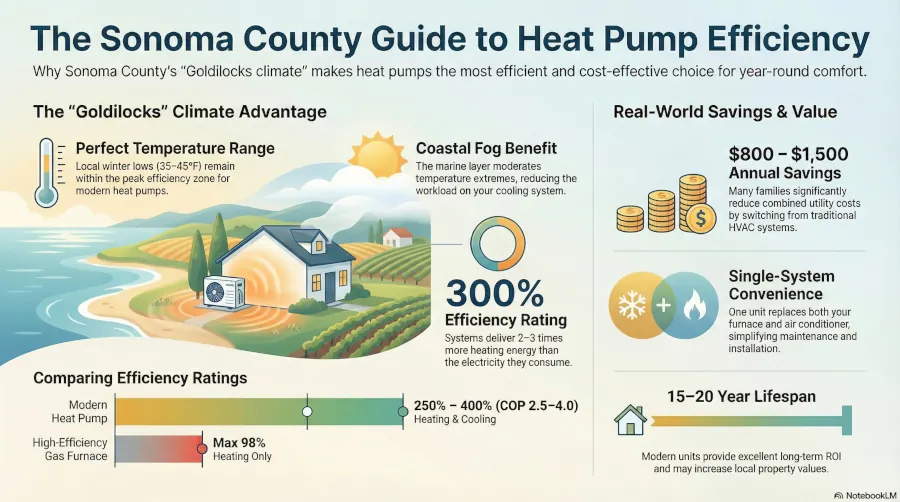
Understanding heat pump efficiency starts with understanding our local weather patterns. Sonoma County enjoys what HVAC professionals call a “goldilocks climate” for heat pump operation—not too hot, not too cold, but just right. Our average winter lows rarely drop below the mid-30s, and even during cold snaps, we seldom experience the prolonged freezing temperatures that challenge heat pump performance in other regions. This moderate climate allows heat pumps to operate in their most efficient range throughout the year, delivering maximum comfort with minimum energy consumption.
The science behind heat pump efficiency is measured by something called the Coefficient of Performance (COP). In simple terms, COP tells you how much heating or cooling energy you get for every unit of electricity consumed. A COP of 3.0 means your heat pump delivers three units of heating for every one unit of electricity—essentially 300% efficiency. Modern heat pumps in our coastal California climate routinely achieve COP ratings between 2.5 and 4.0, depending on outdoor temperatures. Compare this to even the most efficient gas furnaces, which max out at about 98% efficiency, and the advantage becomes clear.
Our proximity to the Pacific Ocean also plays a significant role in heat pump performance. The marine layer that rolls through Santa Rosa and surrounding areas helps moderate temperature extremes, keeping our climate within the ideal operating range for heat pump systems. During summer months, when coastal fog provides natural cooling in the mornings, your heat pump doesn’t have to work as hard during peak afternoon heat. This weather pattern creates opportunities for strategic thermostat management that can maximize your cooling system’s efficiency and reduce energy costs even further.
Real-World Performance: Heat Pump Efficiency vs. Traditional HVAC Systems
When Sonoma County homeowners compare heating options, the conversation often centers on heat pumps versus traditional gas furnaces. While gas has historically been the default choice in Northern California, the economic landscape has shifted dramatically. Rising natural gas prices, combined with improving heat pump technology and PG&E’s tiered electricity rates, have changed the efficiency equation. Many families discover that switching to a heat pump can cut their heating costs by 30-50% compared to older furnace systems, especially when paired with proper insulation and home sealing.
The efficiency advantage of heat pumps becomes even more pronounced when you consider the dual functionality. Traditional homes require separate systems for heating and cooling—a furnace for winter and an air conditioner for summer. This means purchasing, maintaining, and eventually replacing two separate pieces of HVAC equipment. Heat pumps eliminate this duplication, providing both functions in a single, integrated system. The maintenance requirements are simpler, the installation footprint is smaller, and the long-term cost savings multiply over the system’s lifespan.
Several factors influence real-world heat pump efficiency in Sonoma County homes:
- System Sizing: A properly sized heat pump matches your home’s specific heating and cooling needs. Oversized systems cycle on and off too frequently, wasting energy and reducing comfort, while undersized systems struggle to maintain temperature during peak demand periods.
- Installation Quality: Even the most efficient heat pump will underperform if not installed correctly. Proper refrigerant charge, adequate airflow, and correctly configured controls are essential for achieving rated efficiency levels.
- Home Insulation: Heat pumps work most efficiently when your home retains conditioned air effectively. Adequate insulation in attics, walls, and floors, combined with sealed ductwork, ensures your system doesn’t waste energy heating or cooling the outdoors.
- Regular Maintenance: Annual professional maintenance keeps your system operating at peak efficiency. Clean filters, calibrated thermostats, and well-maintained components can improve efficiency by 10-15% compared to neglected systems.
- Thermostat Strategy: Modern programmable and smart thermostats allow you to optimize heat pump operation around your family’s schedule and Sonoma County’s daily temperature patterns, maximizing efficiency without sacrificing comfort.
Cold Weather Performance and Modern Heat Pump Technology
One common concern homeowners express about heat pumps relates to cold weather performance. It’s true that traditional heat pumps lose some efficiency as outdoor temperatures drop, but it’s important to understand what “cold weather” means in this context. The efficiency challenges typically discussed in HVAC literature refer to sustained temperatures below 25°F—conditions we rarely experience in Sonoma County. During our typical winter nights in the 35-45°F range, modern heat pumps operate efficiently and effectively without requiring backup heat sources.
Recent advances in heat pump technology have dramatically improved cold-weather performance. Cold-climate heat pumps, also called hyper-heat or low-ambient heat pumps, now maintain full heating capacity down to 5°F and can continue operating at reduced capacity even at -13°F. While these extreme capabilities aren’t necessary for most Sonoma County applications, the technology means that even our coldest winter nights pose no challenge whatsoever. These modern systems use several innovations to maintain efficiency:
- Variable-Speed Compressors: Unlike older single-speed models that operate at full capacity or not at all, variable-speed technology allows the compressor to ramp up or down gradually, matching output precisely to heating or cooling demand and eliminating wasteful cycling.
- Enhanced Vapor Injection: This technology increases heating capacity and efficiency in cold weather by adding a secondary refrigerant injection cycle that boosts performance when outdoor temperatures drop.
- Intelligent Defrost Controls: Modern heat pumps use sophisticated sensors to detect when frost accumulation on outdoor coils affects performance, initiating defrost cycles only when necessary rather than on fixed timers that waste energy.
- Advanced Refrigerants: Newer refrigerant formulations maintain better heat transfer properties across a wider temperature range, allowing the system to extract heat from outdoor air more effectively even on cooler days.
For Sonoma County homeowners considering heat pump systems, understanding these technological improvements is essential. The heat pumps available today bear little resemblance to the systems installed even a decade ago. Efficiency ratings have improved, noise levels have decreased, and reliability has increased substantially. When properly matched to your home’s needs and professionally installed, a modern heat pump provides whisper-quiet, consistent comfort while dramatically reducing your energy consumption compared to traditional heating and cooling equipment.
Maximizing Heat Pump Efficiency: Practical Steps for Sonoma County Homeowners
Achieving optimal heat pump efficiency involves more than simply purchasing a high-efficiency system. As your neighbors here in Sonoma County, we’ve helped hundreds of local families maximize their heat pump performance through strategic planning and proper system management. The first step is conducting a comprehensive home energy assessment to identify areas where conditioned air might be escaping. Sealing air leaks around windows, doors, and ductwork can improve your heat pump’s effective efficiency by 15-20%, ensuring the comfortable air your system produces stays inside where your family needs it.
The installation process itself plays a crucial role in long-term efficiency. Our experience with local homes has shown that custom ductwork fabrication often makes the difference between adequate and exceptional performance. Every home has unique architectural features, and pre-fabricated duct components don’t always provide the optimal airflow path. Custom fabrication ensures proper sizing, minimal restrictions, and efficient air distribution to every room, helping your heat pump deliver consistent comfort throughout your home without overworking the system.
Ongoing maintenance represents another critical factor in sustained efficiency. According to the U.S. Department of Energy, regular heat pump maintenance can reduce energy consumption by 10-25% compared to neglected systems. This isn’t just about changing filters, though that’s certainly important. Professional maintenance includes checking refrigerant levels, cleaning coils, calibrating thermostats, inspecting electrical connections, and verifying proper airflow. These tasks ensure your system continues operating at peak efficiency year after year, protecting your investment and your family’s comfort.
- Seasonal Filter Changes: Replace or clean air filters every 1-3 months depending on usage, pets, and local pollen levels. Clean filters improve airflow, reduce strain on the system, and maintain indoor air quality while protecting efficiency.
- Strategic Temperature Settings: Set your thermostat to a comfortable but moderate temperature and leave it there rather than making frequent adjustments. Heat pumps operate most efficiently when maintaining a steady temperature rather than recovering from large setbacks.
- Outdoor Unit Maintenance: Keep the area around your outdoor unit clear of leaves, debris, and vegetation. Adequate airflow around the unit is essential for efficient heat exchange, and obstructions force the system to work harder than necessary.
- Annual Professional Inspections: Schedule preventive maintenance before heating and cooling seasons to catch small issues before they become expensive problems. Professional technicians can identify efficiency problems that aren’t obvious to homeowners.
- Ductwork Inspection: Have your ductwork inspected for leaks, damage, or inadequate insulation every few years. Even small duct leaks can waste 20-30% of your heating and cooling energy, dramatically reducing your heat pump’s effective efficiency.
The Financial Picture: Energy Savings and Return on Investment
When evaluating heat pump efficiency, understanding the financial implications helps families make informed decisions. The upfront cost of a heat pump system typically ranges from $5,000 to $15,000 for Sonoma County homes, depending on system size, efficiency rating, and installation complexity. While this represents a significant investment, the energy savings begin immediately and compound over the system’s 15-20 year lifespan. Many local families report reducing their combined heating and cooling costs by $800-$1,500 annually after switching from traditional furnace and air conditioner systems to modern heat pumps.
PG&E’s tiered rate structure actually works in favor of heat pump efficiency. Because heat pumps use electricity more efficiently than resistance heating, and far more efficiently than the energy conversion from natural gas, the total cost per unit of heating delivered often favors heat pumps despite California’s relatively high electricity rates. Additionally, various rebate programs and incentives can reduce your initial investment. Federal tax credits, state rebates, and utility company incentives sometimes combine to offset 20-30% of installation costs, improving the return on investment timeline significantly.
The environmental benefits also translate to financial advantages in our community. Sonoma County has established ambitious climate action goals, and reducing residential energy consumption plays a key role in meeting those targets. As building codes evolve and energy efficiency requirements tighten, homes equipped with high-efficiency heat pumps may see increased property values. Forward-thinking homebuyers recognize that energy-efficient HVAC systems mean lower operating costs and greater comfort, making these homes more attractive in the competitive Sonoma County real estate market.
Climate Compatibility
Sonoma County’s mild climate ideal for heat pump efficiency.
Energy Savings
Heat pumps deliver 2-3 times more energy than consumed electricity.
Environmental Impact
Lower energy consumption reduces carbon footprint.
Long-Term Value
Modern heat pumps offer a lifespan of 15-20 years.
Making the Right Choice for Your Sonoma County Home
Heat pump efficiency in Sonoma County isn’t just good—it’s exceptional. Our mild climate creates ideal operating conditions for these versatile systems, allowing them to deliver consistent comfort while substantially reducing energy consumption compared to traditional heating and cooling equipment. Whether you’re building a new home, replacing aging HVAC equipment, or simply looking to reduce your utility bills and environmental footprint, heat pumps deserve serious consideration. The combination of year-round functionality, reduced energy costs, lower maintenance requirements, and environmental benefits makes them an increasingly popular choice for local families.
Choosing the right heat pump system involves considering your home’s specific characteristics, your family’s comfort preferences, and your long-term financial goals. System sizing, efficiency ratings, installation quality, and ongoing maintenance all influence real-world performance. That’s why working with experienced local professionals who understand Sonoma County homes and climate conditions makes such a significant difference. The right guidance ensures you select a system that matches your needs, installed correctly to deliver the efficiency and reliability you expect.
If you’re considering a heat pump for your Sonoma County home and want to explore whether this technology is right for your family’s needs, we’re here to help. As your neighbors in Santa Rosa, we’ve been helping local families achieve comfortable, efficient homes for years. We’d be happy to answer your questions, assess your home’s specific requirements, and provide honest guidance about your options. Contact us today to schedule a consultation and discover how heat pump technology can enhance your family’s comfort while reducing your energy costs. As a family-owned business, we’re committed to providing the same level of service and expertise to your home that we’d want for our own families.
Frequently Asked Questions
Are heat pumps really efficient in Sonoma County’s climate?
Yes. Sonoma County’s mild winters and moderate summers are ideal for heat pump operation. Because temperatures rarely drop below freezing, heat pumps can run in their most efficient range most of the year. Instead of creating heat, they move it, which allows many local homes to get two to three times more heating energy than the electricity used.
How does a heat pump heat and cool my home?
A heat pump works by transferring heat rather than generating it. In winter, it pulls heat from the outdoor air and moves it inside. In summer, it reverses the process and removes heat from your home. One system handles both heating and cooling, which simplifies operation and eliminates the need for separate equipment.
Do heat pumps work well during cold Sonoma County nights?
They do. Most winter nights in Sonoma County stay in the 35–45°F range, which is well within the efficient operating zone for modern heat pumps. Newer systems are designed to maintain strong performance in cooler weather, so typical local cold snaps do not pose a problem.
How do heat pumps compare to gas furnaces for local homeowners?
In many Sonoma County homes, heat pumps can be more efficient than older gas furnaces, especially as energy costs rise. A heat pump provides both heating and cooling in one system, which can reduce overall operating and maintenance costs. Many homeowners report noticeable reductions in annual heating and cooling expenses.
How do I know if my home is a good candidate for a heat pump?
Homes in Sonoma County with decent insulation, sealed ductwork, and moderate heating and cooling needs are often strong candidates. If your current system struggles with efficiency, has rising energy bills, or is nearing the end of its lifespan, a professional evaluation can help determine if a heat pump is a good fit.
What kind of maintenance does a heat pump need?
Heat pumps benefit from regular maintenance, much like any HVAC system. This includes changing or cleaning filters every one to three months, keeping the outdoor unit clear, and scheduling annual professional inspections. Routine maintenance helps maintain efficiency, prevents unexpected issues, and supports a longer system lifespan.
How important is proper installation for heat pump efficiency?
Installation quality plays a major role in how efficiently a heat pump performs. Correct system sizing, proper airflow, accurate refrigerant levels, and well-designed ductwork all affect comfort and energy use. Even a high-efficiency unit can underperform if it is not installed correctly for your home.
How much does a heat pump system typically cost in Sonoma County?
Based on local projects, heat pump installations in Sonoma County often range from about $5,000 to $15,000, depending on system size, efficiency level, and installation complexity. While upfront costs can be higher than some traditional systems, many homeowners see long-term savings through lower energy bills.
How long does a heat pump usually last?
With proper installation and regular maintenance, modern heat pumps commonly last 15 to 20 years. Keeping up with professional inspections and routine care helps the system maintain efficiency over time and reduces the likelihood of costly repairs as it ages.
Do you install and service heat pumps throughout Sonoma County?
Yes. Heat pump installation, maintenance, and service are commonly provided throughout Sonoma County, including Santa Rosa and surrounding communities. Working with professionals familiar with local climate conditions helps ensure the system is designed and set up for efficient year-round comfort.